87080 Valley Rd Bayfield WI 54814  ph. 715.779.3941
Highland Valley Farm
  • Current Info
  • Map
  • About Us
    • FAQs
    • Job Opportunites
  • Products
    • Wholesale Info
  • Rick's Blog

BLACK CURRANTS:  The European Fruit Our Immigrant Ancestors Were Forced to Leave Behind

8/25/2014

2 Comments

 
Picture
Native to Europe and Northern Asia, black currants are the alternate host to a rust disease affecting five-needle pines--in North America called White Pine Blister Rust.  As the "lumber barons" of the late 19th and early 20th centuries sought to protect their timber interests from Maine to Minnesota, they lobbied their influence for the passage of laws prohibiting the cultivation of black currants.  Inside of a generation, the fruit fell from the ethnic cuisines of newly minted American citizens who had immigrated from countries in Eastern and Northern Europe where black currants are prevalent.  By the late 20th Century, the virgin White Pine forests were gone along with the lumber barons; European fruit-plant breeders were successfully developing new varieties of black currants immune to five-needle pine rust; States were rescinding their laws prohibiting the cultivation of currants; and many Americans were interested to rediscover the traditions and cultures of their ancestors.

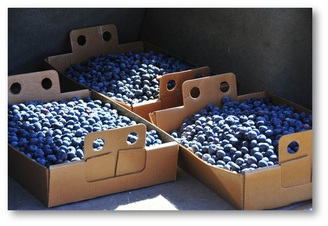
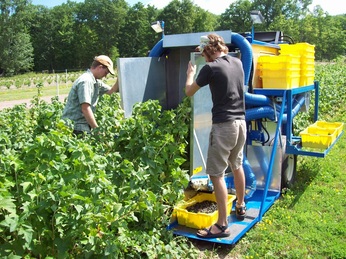
Black currants are predominately utilized as a processing fruit for beverages, jams, jellies and other fruit products.  In Europe it is a common inclusion  in the "rainbow" of fruit flavor offerings. In today's economy, many fruits for process are increasingly picked by machine.  At HIGHLAND VALLEY FARM we have a machine that will pick blueberries for process markets.  The same machine can also harvest currants.

Our initial planting of black currants at HVF was a response to a request from White Winter Winery in Iron River, WI,  which now uses the fruit in its Black Mead table wine, Black Harbor spirits, and Northwoods Naturals Black Spritz carbonated juice beverage. Black currants have since become a staple in our households--black currant jam has become Janet's favorite.  We are expanding production and are now able to offer black currants to our retail and pick-your-own customers as well.   
2 Comments

2014 berry crop outlook

7/22/2014

4 Comments

 
Picture
Three new raspberry varieties will be available for picking at Highland Valley Farm this season.  I have been amazed at the vigor of the new planting.  Only in its second season, the field has set a good crop for this year. Picking will be limited as the field  is still establishing (normally three seasons are required from planting for full production) and the ripening periods will be staggered--Nova fruiting early in the season and Taylor and Royalty fruiting later.  There should be some overlap in the middle of the season when all three varieties will be picking.  For those of you who can be accommodated, picking will be excellent.  Plan to come early in the day as likely we will be picked out by noon on those days the field can be open.   

The first picking will be on Saturday, July 26 and then open again for picking on Tuesday, July 29.  We hope to be open for raspberry picking at least three days per week.  The season will last about four weeks.  Check our "Current Information" page for daily updates.
The Blueberry crop will be heavy.  With little to no winter injury on most varieties, ideal moisture, and perfect early growing conditions, our blueberry bushes have never been more vigorous.  Fruit-set on Chippewa, our primary pick-your-own block, is particularly  heavy.

August IS the blueberry month at Highland Valley Farm.   We will open for blueberry picking beginning Saturday, August 2, one week later than predicted in our annual newsletter. Every effort will be made to be open six days per week--Tuesday through Sunday, however weather or management issues can always interrupt this schedule.  Be sure to check for daily updates on our "Current Information" page on this website before making the trip to the farm.

The "kids" are doing a great job again this season managing the crops.  The organic fertilizer program has been a great success. Audits from Food Alliance for our sustainable farming program, and the USDA for "safe food" and farming practices, passed with high marks.
Picture
4 Comments

Have our fruit plantings been hurt by cold weather?

3/16/2014

1 Comment

 
Picture
The winter of 2013-14 has been one of the coldest our region has suffered in more than 25 years.  Many people are concerned for the condition of fruit crops at Bayfield and have asked whether or not our berry crops have been damaged for the coming season due to cold injury.

It may be of interest that temperate zone perennial fruit crops actually require a cold dormant period to effect the necessary hormonal changes the plants need to initiate fruit bud-break in the spring.  Northern hardy blueberry varieties can require more than 2,000 cumulative hours of annual chill (temperatures below +40F) for proper function. That said, perennial fruits in some years can be damaged when subjected to severe conditions.

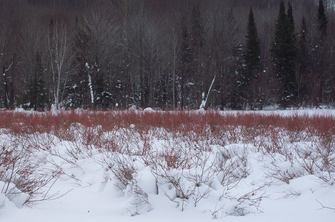
It should provide some comfort to know that the varieties that knowledgeable growers plant at Bayfield are appropriate for our climate--in the case of our blueberries, most varieties are hardy to -30F or even colder when the plants are fully dormant.  In addition, our Lake Superior peninsular climate at Bayfield mitigates the extremes of temperature.  The coldest temperature recorded at Highland Valley Farm so far this winter has been -22F, that is 10 to 15 degrees warmer than our neighbors inland, or to the west of us in Minnesota, experienced this season.  Also, the cold has been consistent with no erratic fluctuations or prolonged mid-winter thaws.  Finally, we are normally favored with a deep insulating snow cover that most years comes early and stays late. This year the snow cover is exceptional, measuring 42 inches settled on the level in our open fields in February.  As cold as it has been, there is little to no frost in the ground on our sandy soils, and even 2/3 of the branches of our plants have been covered for most of the winter.

It all depends on what happens over the next several weeks.  Cold injury most often occurs during the late winter period in years when temperatures are erratic or "unseasonable".  Plants that have accumulated sufficient chill will respond to warm ambient temperatures--especially as snow cover is lost--and will break dormancy.  A return to colder temperatures after a loss of plant dormancy can result in injury and reduction of crop in the coming season.

Earlier this month I sectioned fruit bud samples from our fields to determine the extent of this season's winter cold injury to date.  The degree of injury was minor in most varieties.  Compared with samples taken on the same date from the preceding season's relatively mild winter, the level of injury for the current winter season is less.   Last year's blueberry crop was normal.  This year's crop could be as good or even better.  I am optimistic, but then I am a farmer.

1 Comment

BERRY CROPS FOR eMERGING DEMOCRACIES IN EUROPE

12/14/2013

5 Comments

 
Picture
Nations emerging from recent conflicts, failed communist economies, and political rearrangement in South-central and Eastern Europe have been crippled with shuttered industries, collapsed infrastructure, high unemployment, and low GDP.  Rural communities in these regions are particularly desperate for new direction, investment, and opportunity.  I recently returned from Former Soviet Moldova where 17% of the GDP is based on agricultural production and food processing.  Agricultural product represents 50% of exports, but farming has long been in decline, as large state farms and centralized agricultural systems have deteriorated or been abandoned.  Labor has fled the country for employment opportunity in the West.  38% of Moldova’s GDP this past year was from stipends sent home from family members working abroad.  Rural villages with a farming tradition are now disproportionately populated by the elderly and women.  Investment in small production units of high-value "cash" products for domestic markets, and larger commercial production of the same products for targeted export, could have a positive impact in beginning to rebuild an agricultural economy for countries like Moldova.  The immediate opportunity presented by increased demand for hand-harvested fresh-market berries in Europe could make a large contribution towards this goal.

In the Republic of Georgia, after several years of USAID supported exploratory efforts, the first fledgling private farms to reclaim abandoned State tea plantation land shipped 60 tons of highbush blueberries to Western markets in 2013, and an additional 250 acres of new blueberry plantation was established.  Former small-farm stakeholders of USAID berry development projects in Serbia banded together in Bajina Basta to form an association, built a small cold-storage facility, and this year sold their blueberry harvest to eager buyers in Germany for $3.75/lb.  In Kosovo, raspberry farmers are realizing that their traditional hand-harvested fruit-for-process is rapidly becoming non-competitive with machine harvested raspberries from larger farms in Poland and other production areas in Europe.  USAID’s NOA project is assisting these farmers to transition to new varieties suitable for fresh markets where they are realizing an 8 to 10 fold increase in the prices they are paid.

Janet and I vacationed in the Balkans during September and had the opportunity to visit farmers I had worked with several years ago to establish blueberry crops.  Has our effort made a difference?  One young family reported that during the last two years their farm income had doubled as the result of entering blueberry markets.  "...and the village?", I asked.  "When the blueberry project began there were five farms planting this new crop."  my friend replied. "Now there are more than twenty.  Blueberries are making a big difference for all of us."  

Berries:  high-value, labor-intensive, economically sustainable on small areas—the perfect family-farm enterprise— and an exciting development opportunity making a difference in Eastern Europe.


5 Comments

update on the Airport controversy

9/12/2013

2 Comments

 
Some of you have asked:  What was the outcome of the legal battle against the private recreational airport development proposed for a site just north of Highland Valley Farm?  After all the controversy--five years of contentious public debate in municipal town halls, the Bayfield County board room, and the courts--you would expect that there might have at least been an article in the local press announcing the recent ruling from the Wisconsin State Court of Appeals.  Go figure!  But, I'm pleased to be able to tell you, WE WON! 

On July 30, 2013, Judge Eaton, handed down the decision of the State Court of Appeals upholding the decision of the Bayfield County Board of Adjustment (BOA).  Earlier, after considering the evidence revealed from 8 1/2 hours of testimony and a mountain of documents, the BOA had overturned the County Board's snap decision to grant a building permit to the developer.  Requesting a "change of venue" following Judge Anderson's decision upholding the BOA, the issue was appealed by the developer to the State Court of Appeals and Judge Eaton--where the developer was defeated again.  The next recourse would be for the developer to appeal to the State Supreme Court, but the period for requesting that appeal has lapsed, signaling that the developer is throwing in the towel--at least for now...

This project was threatening in so many ways.  Of course the thought of how our family's farm business and our quality of life would have been impacted living under the low-level path of frivolous air traffic was upsetting to us--but the entire Bayfield and Apostle Islands area would have been subjected to the intrusive "flight seeing" activities of these recreational aviators.  In the end, however it was the environmental fragility of the site itself--steep and highly erodible land, in close proximity to a large wetlands that is headwaters to the Pike's Creek trout waters feeding into the fish hatchery and Lake Superior--that brought the strongest rebuke from the BOA and the courts.

Joyful as my family, friends, neighbors, and supporters are for this outcome, we realize that in the cause of conservation constant vigilance and perseverance are required.  We have won a battle--but there will always come another threat.  When the land is bulldozed and concrete is poured, the developer wins the war--piece by piece.  But, for now we will celebrate.  Sometimes the "little people" can win.  There would not have been a victory, however, without the courage of our neighbors standing together and the generous support of Counselor Shari Eggleson who represented our cause to the end "Pro Bono".
2 Comments

Returning from time away

7/6/2013

12 Comments

 
Picture
I'm just back from a another contract consultancy in Kosovo.  One of the first things I have to do upon returning home from an overseas assignment is an inspection of the farm--preferably in the early morning with a cup of coffee in hand.  It always amazes me how much change occurs during my two to four week absences.

It's been a very late, cool, and wet early summer at Bayfield.  You might think that that would be bad for things that grow--and maybe you'd be right  if you were thinking of corn and soybeans--but we farm berries.  Berries thrive in cooler temperate climates and their fruits are nearly 90% water; so if bigger is better, lots of moisture can be a good thing.  Our crops will be late this year, but I have never seen the blueberries looking better.  In the short time I was gone, the bushes have exploded in new growth, with some vigorous shoots already 20 inches or more in length with large, glossy, deep green leaves.  Most of the fruit has set, and it is exciting to see the many large clusters of green berries that promise a bountiful harvest if we will be patient and continue to be attentive.

As good as "cool and moist" can be for berries, these conditions can also be "too much of a good thing" where soils are heavier and less well drained.  Such is the situation of our present Raspberry field.  Despite our efforts to affect drainage with drain tile, ditches, and raised beds, many of the plants have been severely affected this season by phytophthera fungus--commonly called "root rot" or simply "wet feet".  There likely will be raspberries--but not what we had hoped for--so we will have to lower our expectations for this season, heed the lessons Mother Nature is teaching, and resolve to do better for the future.  Chris and Magdalen just finished planting a large new field of raspberries on a site we hope will be better prepared and better suited to the crop.

Despite the weather, Jon has made great progress on our new USDA engineered facility for safe mixing of farm chemicals, cleaning and garaging of related implements, and storage of related equipment and supplies.  It will be the first of its kind at Bayfield--a model for environmental protection in the region.  The complicated concrete work is complete and he is nearly ready to begin framing the remaining structure.

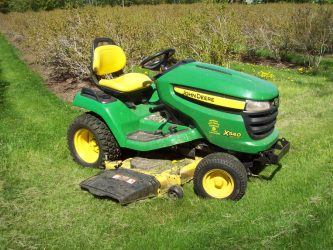
The other change that occurred during my absence is the length of the grass.  One can hardly keep up with it in this season.  Its time for me to get back outside and do my part for this family enterprise!


12 Comments

If it's organic it's safe, right?

6/19/2013

16 Comments

 
Recently Food Safety News published an article on its website  commenting on the recent Hepatitis-A contamination of a USDA Organic labeled  frozen berry mix from an Oregon based packer.  The author of the article  was incredulous that a certified  Organic product should be contaminated with a harmful micro-organism AND that a part of the berry mix had been sourced from Turkey (believed to be the source of the contamination).  Most of the reader response to the article revealed an ignorance that equaled the author's.  As a consultant who provides assistance to berry farmers in developing countries and as a farmer concerned for sustainability and safe food, I felt compelled to respond: 

"If you are going to write and publish articles about food safety, then I think you ought to know something about standards for certification. This Hepatitis-A contagion from frozen berries has NOTHING TO DO WITH ORGANIC STANDARDS!!!"

"Organic production is all about inputs--naturally derived vs. synthetically derived--i.e. fertilizers, pesticides, growth regulators, colorings, GMOs, preservatives, sanitizers, etc. Organic standards also have nothing to do with food being from local or from multiple sources, domestic or foreign. In addition Organic standards do not provide protection from contamination of food with micro-organisms such as those referenced in your article. The sources of Hepatitis-A, E-coli, Listeria, Salmonella and other harmful organisms that can contaminate fruits and vegetables are uncomposted manure, contaminated irrigation and wash water, dirty hands, sick farm workers, less than sanitary harvest equipment, trucks, packing houses, coolers, re-used packaging, farmers market tables, and grocery store produce counters, Good Agricultural Practices (GAP certification) and Good Handling Practices (GHP certification) are the standards that address these food safety issues. I find it very interesting that the bulk of the food safety threat AND the majority of produce recalls have to do with micro-organisms--many times emanating from Organic sources and value chains. Still, if its ORGANIC it must be safe, right?"
16 Comments

RICK PROVIDES ASSISTANCE TO BLUEBERRY GROWERS IN BELARUS

5/31/2012

16 Comments

 
Picture
I recently returned from a two week USAID CNFA Farmer to Farmer assistance assignment in Belarus. Unique from most former Soviet Republics in that it has largely retained its authoritarian government, centralized economy, and collective farm system, Belarus can be a challenging environment for entrepreneurial enterprise. Poland, its western neighbor has emerged as a major producer of berry crops for Western Europe. With comparable soils and climate, Belarus could also be a major producer of berry crops in Europe, especially blueberries and cranberries.

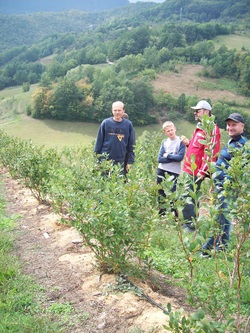
North American highbush blueberry culture is well established with more than 200 farms--both state owned and private--currently producing a crop destined for markets in Russia. However, the fledgling industry is constrained by a lack of technical information, specialized inputs, modern processing machinery, investment capital, open markets, and a lack of privately held land. Rick lectured on topics pertaining to blueberry production at Poliss State University in Pinsk and offered consultation to a variety of farmers across southern and central Belarus. People were warm and welcoming at the farms visited, "hungry" for the contact from "outside", and appreciative of the information that was presented.


16 Comments

Rick "retires"

12/15/2011

4 Comments

 
Picture
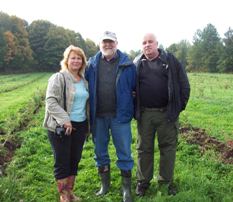
It's been in the works for a while as I have looked forward to "retirement"--I am pleased to announce that my son, Jon has taken over as General Manager for our family farm business. He returned home nearly three years ago, after more than a decade of employment in Seattle. He is partnering with his siblings to continue the legacy of the farm business my wife and I established and that they grew up with.

The farm will be in good hands as Jon has had considerable project management experience. He is an excellent financial manager and is committed to carrying on family traditions. Many of you have been witness to Jon's skills as he directed construction of our new processing and cold storage facility. He has also had primary responsibility these past two years for our wholesale accounts, and this past season directed processing and packing operations. My son Chris continues to be responsible for production, while my daughter Magdalen continues to direct seasonal employees, promotion, and retail sales. Janet continues as Office Manager and I will have the luxury now of doing as much of "what I want to, when I want to"--farmers never really retire, but they are truly blessed when they have sons and daughters who want to carry on.

4 Comments

"BAYFIELD BLUES" BRAND REGISTERED TO HVF

9/2/2011

4 Comments

 
Picture
It is official. On August 9, 2011, the United States Patent and Trademark Office in Washinton, DC, registered "Bayfield Blues" as the exclusive trademark of Highland Valley Farm at Bayfield, Wisconsin.

We have actually been recognized in the market place as "Bayfield Blues" since 2004 when the label was first used--but even before that, sales representatives for Minnespolis & St.Paul based distributors identified blueberries from HIGHLAND VALLEY FARM as "Bayfield Blues"--we liked the identification with the place--and the name stuck. Now we are proud to have exclusive rights to the brand.


4 Comments
<<Previous
Forward>>

    Rick Dale

    Founder
    ​ of Highland Valley Farm

    Picture

    Archives

    April 2023
    August 2022
    March 2022
    December 2021
    August 2021
    February 2021
    December 2020
    September 2020
    July 2020
    May 2020
    April 2020
    February 2020
    December 2019
    November 2019
    July 2019
    March 2019
    January 2019
    November 2018
    October 2018
    April 2018
    March 2018
    December 2017
    June 2017
    May 2017
    April 2017
    January 2017
    November 2016
    September 2016
    June 2016
    January 2016
    November 2015
    July 2015
    May 2015
    January 2015
    November 2014
    August 2014
    July 2014
    March 2014
    December 2013
    September 2013
    July 2013
    June 2013
    May 2012
    December 2011
    September 2011
    July 2011

    Categories

    All

    RSS Feed

Powered by Create your own unique website with customizable templates.